
The Roots of Climate Resilience
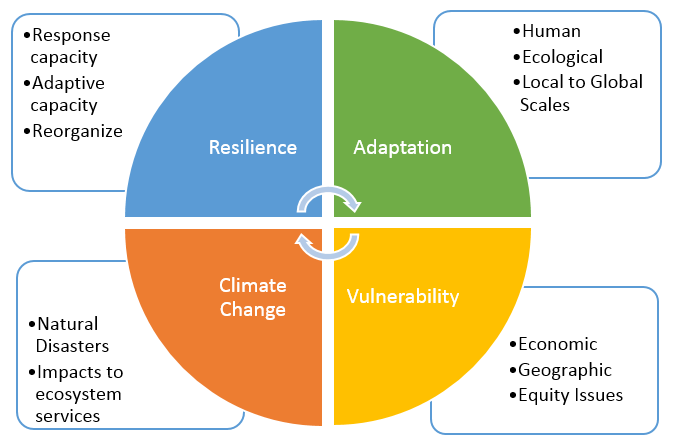
Image: Climate Resilience Model
Climate resilience is everywhere. A buzzword now rivalling ‘sustainability’ in popularity, climate resilience refers to the capacity of ecosystems, climates, and societies to remain stable in the face of climatic disruptions and disasters. Cities worldwide have employed ‘Resilience Officers’ to make urban environments more ‘resilient’ to the existential threats posed by climate change. But what does the history of this concept reveal about its past and present lives? And in an era where climate change is creating problems far beyond any individual family or community’s capacity to tackle, is it helpful for the future?
The concept of climate resilience, or variations on it, have been in use since at least the 1970s, during the earliest global discussions of climate change and its risks. Resilience as an ecological concept was coined by ecologist C.S. Holling in 1973. Holling challenged the idea of “balance” as the fundamental principal of ecosystems and argued that these were constantly exposed to shocks, which some could absorb, while others simply collapsed. The amount of pressure systems could absorb while remaining stable – their resilience – Holling famously argued, was of particular importance in natural resource management. Scientists studying climate change subsequently adopted this term to describe the resilience of climate itself to shocks, and of societies to respond to climatic disasters.
“Climate resilience” as a specific term, emerged slightly later. The first example of this term that I found appeared in a 1982 US Congress hearing about the potential impacts of fossil fuels on the Greenhouse Effect. Here, Carroll Wilson, a Professor at MIT and advocate of coal use, suggested that making agriculture more “climate resilient” would allow the US simultaneously to mitigate against the risks of climate change, while continuing to burn vast amounts of fossil fuels. So, from the first use of this term, it provided justification for a “business as usual” approach to climate change.
Meanwhile, similar terms like “resilience to climate variability”, were adopted by the World Meteorological Organisation, the United Nations Framework Convention on Climate Change, and the Intergovernmental Panel on Climate Change in numerous discussions and strategies on how to tackle climate change. These scientists weren’t promoting a “business as usual” approach, but treated resilience as a pragmatic measure to mitigate against some of the effects of climate change they felt could not be prevented.
Thus, from the 1970s to today, “climate resilience” has undergone a number of meanings and intentions. Firstly, improving climate resilience was a pragmatic (or defeatist) strategy, which implied a tacit acceptance that although some impacts of climate change could not be avoided, societies could prepare themselves against them. Secondly, it was a way for advocates of fossil fuel use to deflect difficult questions about the potential impacts of their activities on climate and human societies. Finally, as the historian Jeremy Walker has argued, it has a disturbingly Social Darwinist slant – that only those who are “resilient” are fit to survive the current century.
Given its history, is this concept helpful for tackling the climate crisis? On the one hand, individuals have little choice but to try to adapt to climatic changes that are affecting the world in such uneven, unequal, and unfair ways. But on the other, climate change is a problem far beyond individual responsibility. Individual households and communities cannot be expected to be resilient in the face of 50 degree temperatures, flash floods that destroy homes and infrastructure, and wildfires that turn the skies orange and rain ash on town and countryside alike.