Reflecting on developing ‘Summer in Paris: An Illustrated Journey Through History and Heat’
The full graphic novel is now available to read online here.
In the summer of 2024, the idea for a graphic novel about experiences of heat in Paris started germinating when Prof Chris Pearson and I began to discuss ways to bring together my research, public engagement, and creative methods.
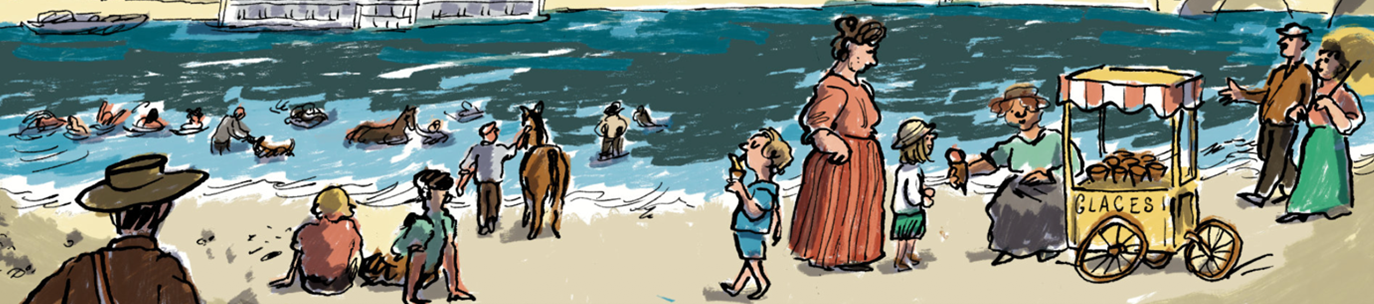
Why a graphic novel?
In France and the Francophone world, the roman graphique or bande dessinée is a popular format of publication. In recent years, scholars, scientists, and journalists have published their research and enquiries using this format. History, climate change, and environmental questions are topics that feature prominently in this genre. Adding my own research on the evolutions of human-heat relationships through time to this body of work seemed a natural path to take. There is power in visual narratives, especially those that can show what we cannot see. In itself, heat is invisible. It is only the effects it has on people, objects, and events that we can hope to capture. Working with an artist made it possible to bring to life the diverse manifestations of heat through time, as I view and interpret them in the archives that I examine.
From the outset, the graphic novel––now titled Summer in Paris: An Illustrated Journey Through History and Heat––was to be a collaborative project between historian and artist, a story based on in-depth academic research and fiction.
My aims were to show the intersections of urban life and heat, present academic research in an engaging way, and encourage readers to think about the interactions of history and climate.
With Summer in Paris, I wanted to explore and prompt reflections on a range of questions. What was the impact of heat on the daily lives of Parisians at different moments in time? How did heat shape historical change? How did evolutions in society affect responses to heat? What practices and cultures did people develop as they coped with, embraced, or protected themselves from the heat? How can the past inform our relationship with heat in the future?
The next stages
In spring 2025, artist Elly Bazigos joined the project. As part of our collaboration, we visited Paris at the end of summer to get a sense (literally) of the spaces and objects that were going to feature in the novel: the small, winding streets of the Marais and the wide avenues leading up to the Opéra Garnier; the sun reflecting on cobble-stones on the Seine banks; the intricate decorations of Wallace fountains. These experiences and Elly’s live sketches have directly fed into the work.
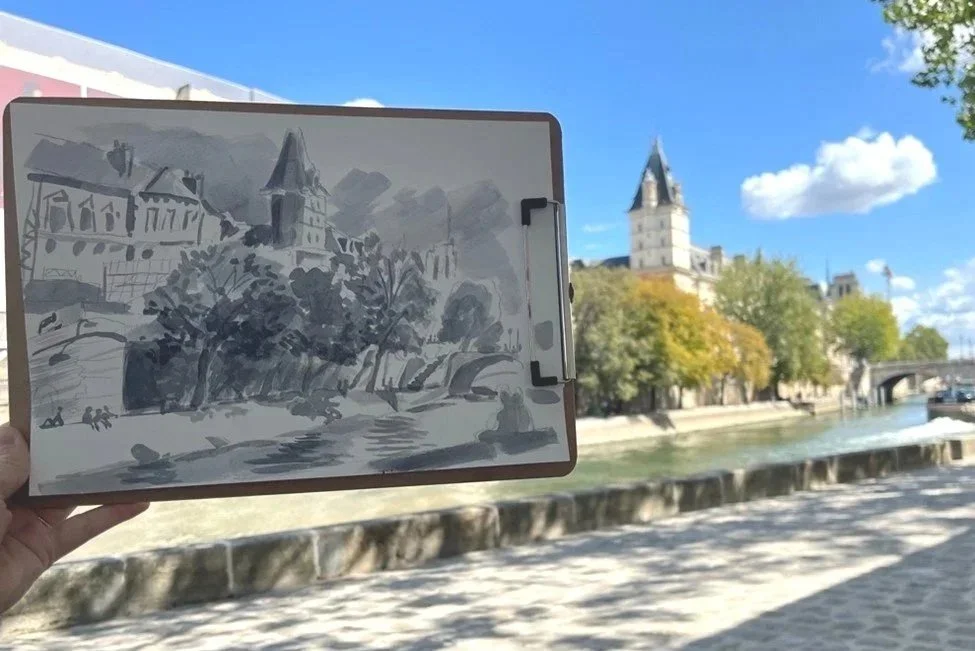
Afterwards came the process of writing the scenarios for the different sections of the graphic novel. Each vignette––its location, characters, actions––addresses the themes (such as urban transformations, health, policy, cultures) that emerged in my examination of the meeting point of people, city, and heat at key moments in time. Two main questions guided my work of building the stories, dialogues, narration, and characters––What do I want to achieve with the stories? How can I translate the written research into a narrative that works visually?
The process involved a shift in approach. As the story is spelled out on two levels at the same time, with the word and the image, not everything needs to be explained in the speech bubbles or narrator frames (unlike in traditional academic publications where only the written word carries the narrative). The artist shows many elements of the story––pearls of sweat, melted ice-creams, sleepless nights. Therefore, the written elements become opportunities to add to the narrative of human-heat relations by outlining arguments and foregrounding the research.
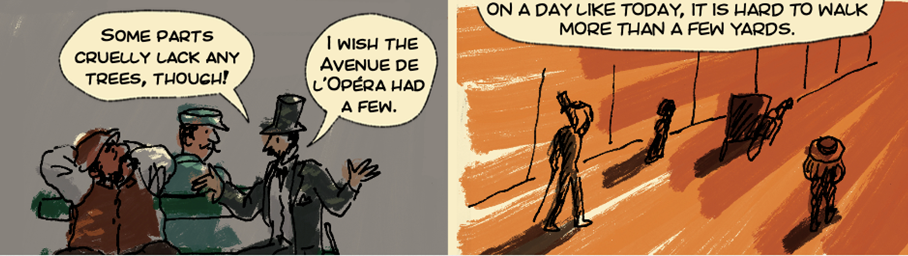
It also involved character-building and place-making. Some of the protagonists are real individuals, and others are combinations of different historical figures. Most characters are fictional beings, with their backgrounds allowing me to explore specific themes and questions, based on my own primary source research and the work of other historians. Each vignette starts with a bird’s-eye view of the same street at different points in time. The street reflects the physical transformations of the urban landscape and evolutions in uses of the space. As the novel moves forward in time, horses are replaced by cars, which in turn give way to pedestrianised areas; some buildings are demolished while others are standing still; top-hats are dropped and hemlines are going up.
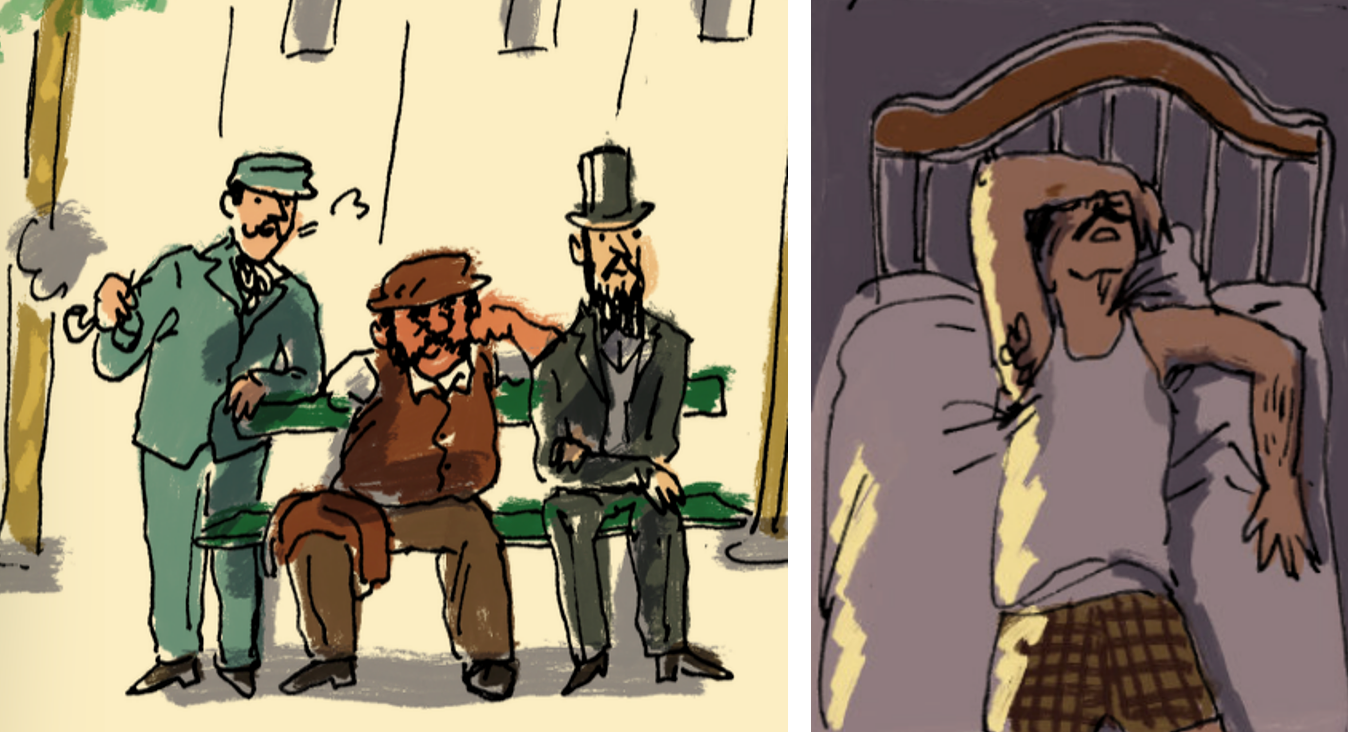
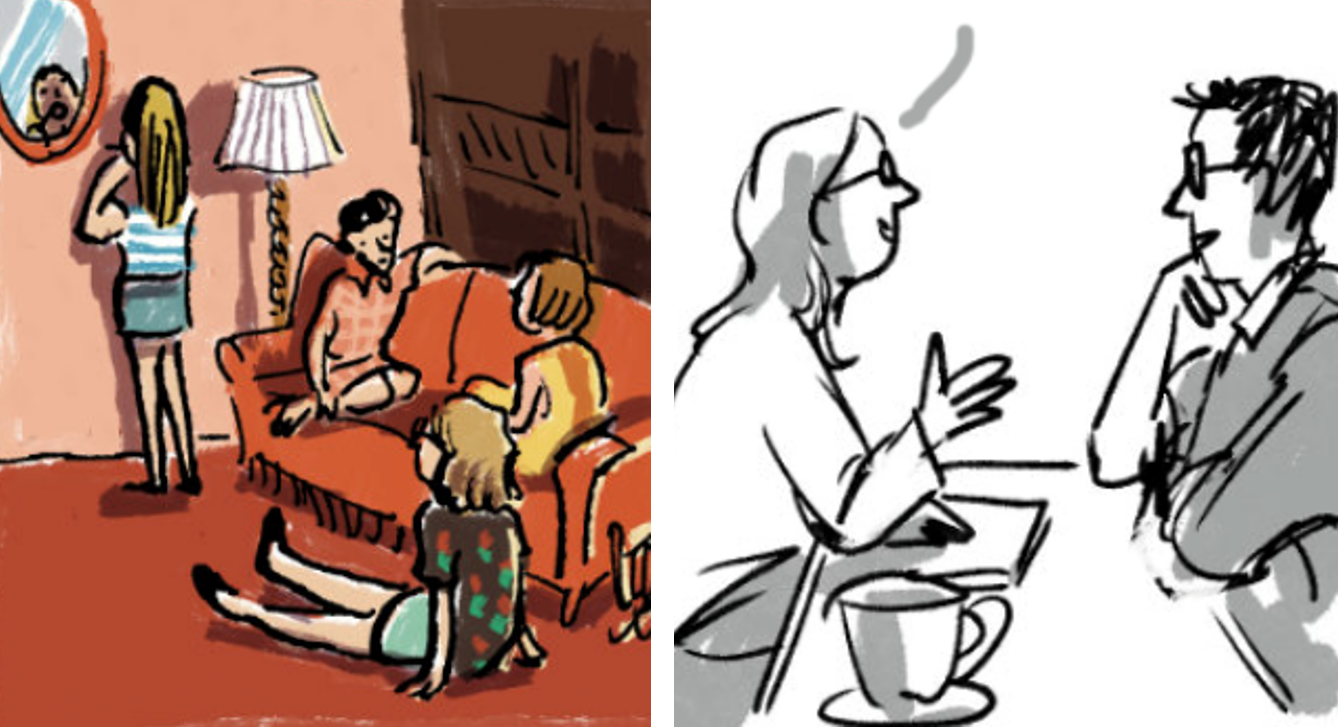
Then, I shared this work with Elly, who interpreted, sketched, inked, and coloured the vignettes.
The first story, set in 1886, examines how the physical and social transformations of nineteenth-century Paris changed people’s experiences of summer heat, both outdoors and indoors. The second story takes place in 1911, during the heatwave that caused devastation as urbanites struggled to cope with the prolonged scorching heat. Then, the novel moves to 1968 and considers the ways in which post-war hygiene practices, consumer society, and youth culture refashioned experiences of summer. The fourth episode deals with the heatwave of 2003, which marked a turning point in the ways in which officials and public health authorities approached and responded to crises. The final section unfolds in the present day, in the context of ever-accelerating climate change and the need to take the issue of urban heat seriously, undertake research into lived experiences, and develop adaptation strategies.
What’s next?
Summer in Paris will be available to read online at the end of May.
A launch event will take place on Tuesday 23 June 2026, 5-7pm at Hypha Gallery 2, 1 Poultry, London, EC2R 8EJ.
At the launch, historian Chloé Duteil and artist Elly Bazigos will present the graphic novel, discuss the process of collaborating to turn academic research into a visual story, and lead a creative activity around drawing history. It will also be an opportunity to engage with the work of Melting Metropolis, the broader research project that the graphic novel is part of.
The event is hosted by London's Climate Story Bank. It is free to attend, but booking is required via this Eventbrite link. Refreshments will be provided.